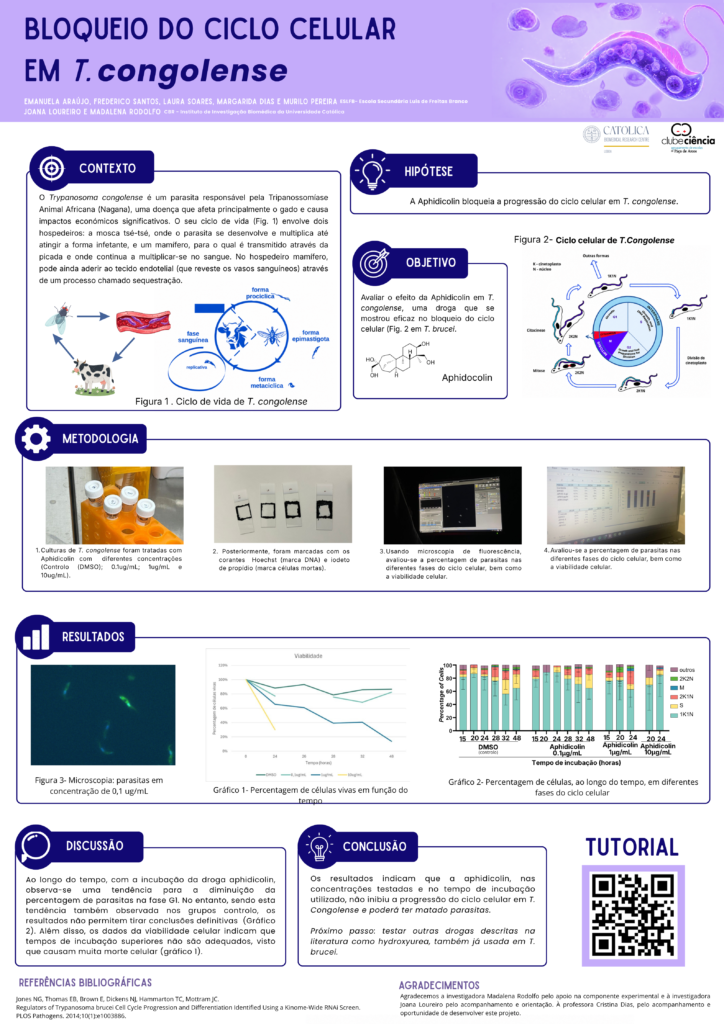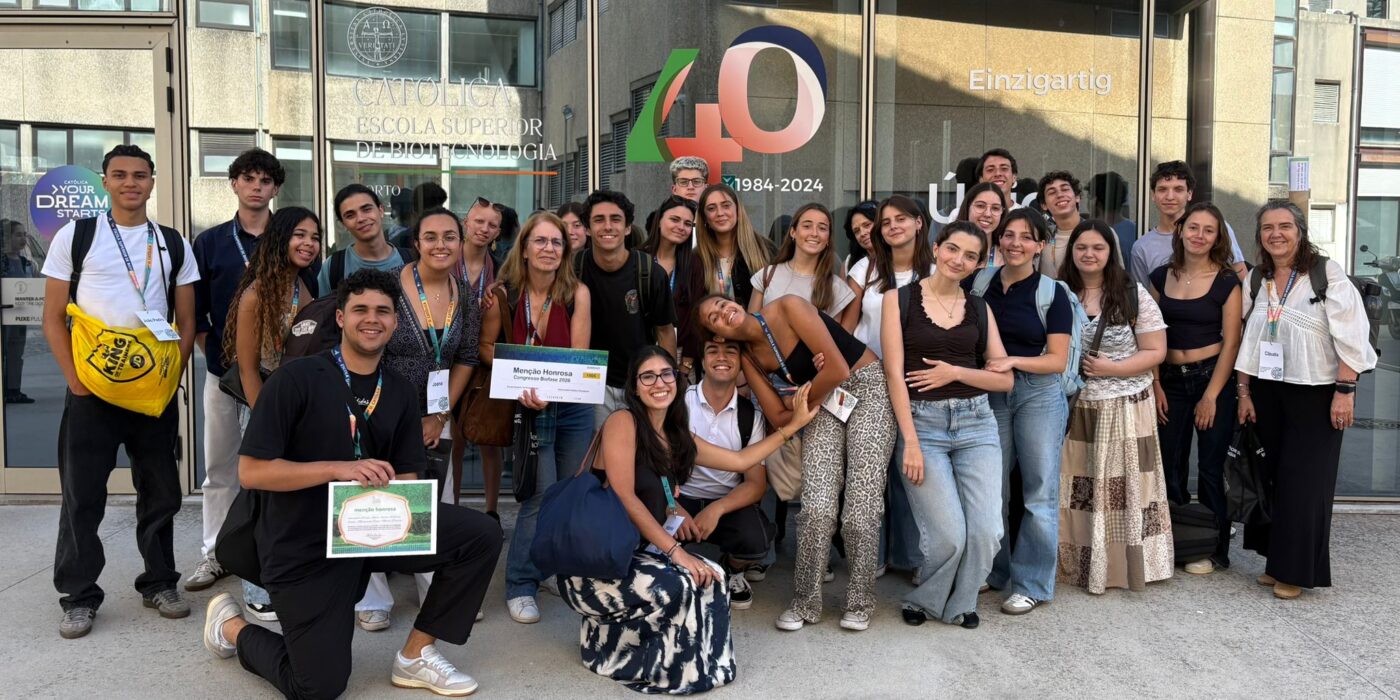
The poster presented by a group of five students from Luís de Freitas Branco Secondary School (ES LFB), in Paço de Arcos, Oeiras, at BIOFASE III – the 3rd Congress on Bioengineering Research in Secondary Education, held on 27 May in Porto, received the event’s Honorable Mention and Award for BEST POSTER. Congratulations to the students — Emanuela Araújo, Margarida Dias, Murilo Pereira, Frederico Santos, and Laura Soares — as well as their Biology teacher, Cristina Dias, and the group’s mentor, Madalena Rodolfo, who supervised the work carried out at CBR. Madalena is a member of CBR´s Parasite Vascular Interactions Laboratory, led by Sara Silva Pereira. (see News piece here)
The poster presented by a group of five students from Luís de Freitas Branco Secondary School (ES LFB), in Paço de Arcos, Oeiras, at BIOFASE III – the 3rd Congress on Bioengineering Research in Secondary Education, held on 27 May in Porto, received the event’s Honorable Mention and Award for BEST POSTER. Congratulations to the students — Emanuela Araújo, Margarida Dias, Murilo Pereira, Frederico Santos, and Laura Soares — as well as their Biology teacher, Cristina Dias, and the group’s mentor, Madalena Rodolfo, who supervised the work carried out at CBR. Madalena is a member of CBR´s Parasite Vascular Interactions Laboratory, led by Sara Silva Pereira.
The poster, entitled “Cell Cycle Arrest in T. congolense”, described the work undertaken by the students and Madalena to evaluate the effect of the antibiotic aphidicolin on the parasite Trypanosoma congolense. Previous studies had shown that aphidicolin, a drug used to inhibit DNA replication in eukaryotic cells and halt cell-cycle progression, is effective in blocking the cell cycle of T. brucei, another species of trypanosome. Trypanosoma brucei and Trypanosoma congolense are protozoan parasites transmitted by the tsetse fly and are responsible for animal trypanosomiasis (Nagana) in livestock across Africa. The main differences between the two parasites lie in their host range, localization within the insect vector, and pathogenicity. Understanding the factors that determine these differences in pathogenicity is precisely the focus of Sara Silva Pereira’s research.
BIOFASE is an event for students and teachers from grades 10 to 12 who develop scientific projects and research work. The Congress is organized by Universidade Católica Portuguesa (UCP)´s Biotechnology School in Porto. Its theme is bioengineering, with a focus on solving real-world problems through biologically based tools, ranging from microbiology and biotechnology to health and environmental applications. BIOFASE III took place on 27 May 2026 at the School of Biotechnology of the Catholic University of Portugal in Porto. As in previous editions, the day featured plenary sessions, invited speakers, discussion groups, oral presentations, and poster evaluations. The best student oral presentation and the best poster received an Honorable Mention and a monetary award (€150 and €100, respectively). The Congress is held within the framework of the BLUE DESIGN ALLIANCE project, funded through Portugal’s Recovery and Resilience Plan (PRR) for the period 2021–2026.
👉 More information here: BIOFASE Award Oeiras students and CBR | CBR