

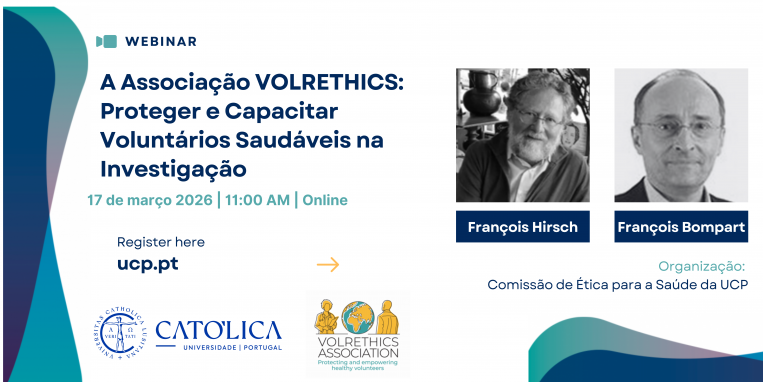
The Health Ethics Committee of the Universidade Católica Portuguesa (UCP) is organizing a webinar dedicated to the presentation and contextualization of the VOLRETHICS Association, an international initiative launched in 2022 by the Institut National de la Santé et de la Recherche Médicale (INSERM), with the aim of protecting and empowering healthy volunteers involved in scientific research.
March 17th, 2026 | 11h00 AM – 12h30 PM | Online | Microsoft Teams
Language: English
With the collaboration of VOLRETHICS Association’s Board: François Bompart, François Hirsch, Lorenzo Montrasio, Luc Bigel, Nadina Stadler, Shadreck Mwale, Yves Donazzolo.
With the participation of the Vice-rector of Universidade Católica Portuguesa:
Professor José Manuel Pereira de Almeida
Moderation: Mara de Sousa Freitas, President of the UCP Health Ethics Committee (CES-UCP)
WHY THIS TOPIC?
While robust legal frameworks exist to protect patient-participants in research, healthy volunteers often remain insufficiently protected, despite the fact that:
- They cannot expect direct health benefits from their participation;
- They are subject to demanding protocols that may affect their well-being;
- They are often motivated by financial compensation, which may increase the risk of exploitation in situations of economic vulnerability.
To address these challenges, VOLRETHICS published in 2024 the First Global Ethics Charter for the Protection of Healthy Volunteers in Clinical Trials, now available in 10 languages, including Portuguese.
OBJECTIVES OF THE WEBINAR
- To present the VOLRETHICS framework and its relevance for academic and research institutions in Portugal;
- To reflect on the transition from an ethics model focused primarily on regulatory compliance to a proactive, reflective, and responsible research culture;
- To discuss the central role of Health Ethics Committees in promoting scientific integrity, public trust, and social responsibility.
KEY QUESTIONS FOR DISCUSSION
- How can specific attention to healthy volunteers complement existing regulatory frameworks?
- What role can Health Ethics Committees play in effectively protecting these participants in everyday research practice?
- In what ways can the VOLRETHICS framework contribute to strengthening scientific integrity and public trust in research conducted in Portugal?
- What institutional strategies are needed to support researchers in addressing complex ethical dilemmas with autonomy and accountability;
Free access | Registration required
An open session for researchers, ethics committee members, institutional decision-makers, and all those interested in ethically robust, responsible, and socially committed scientific research!