

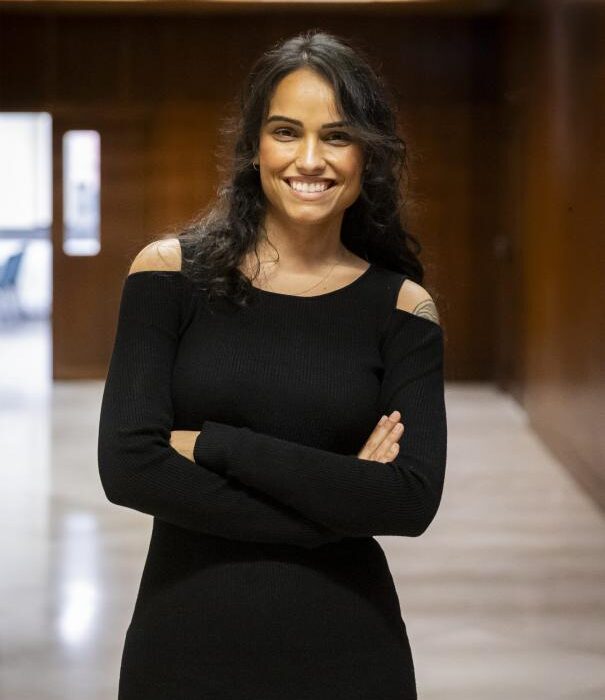
Sara Silva Pereira is a researcher at the Católica Biomedical Research Centre (CBR) and a lecturer at the Faculdade de Medicina da Universidade Católica. Since 2023, she has headed the CBR’s Parasite–Vascular Interactions Laboratory, where she investigates how African trypanosomes – the parasites responsible for sleeping sickness – interact with their mammalian hosts. In 2025, she was awarded the BSP President’s Medal by the British Society for Parasitology, in recognition of the international impact of her work.
What comes to mind when we hear the word “health”?
S.S.P – It is natural to think of hospitals, medical appointments and personal habits. But on this World Health Day, I challenge us all to remember a simple yet urgent truth: human health does not exist in isolation. It depends on our behaviour and genetics, of course, but also on the quality of the environment and the health of the animals around us. We call this integrated approach, which brings together surveillance and diagnosis, human and veterinary medicine, laboratory science and fieldwork, fundamental and translational research, “One Health”.
Why does this matter?
S.S.P – What happens “out there” rarely stays “out there”. Climate change alters the distribution of vectors (such as insects). Human and animal mobility shortens distances. The way we use the land – urban areas, rural areas, forests, watercourses – alters the interactions between people, domestic animals and wildlife. It is at these intersections that more effective responses emerge: vector control, monitoring programmes, and better-informed treatment decisions. One Health helps us to prevent rather than merely react.
Parasitology
S.S.P – Parasitology is, by its very nature, a One Health discipline. Parasites and vectors circulate between humans, domestic animals, wildlife and ecosystems, and find opportunities created by climate change, globalisation and changes in land use. The impact can range from silent infections to outbreaks with clinical, social and economic consequences.
A four-legged example
S.S.P – African animal trypanosomiasis, or nagana, is the veterinary variant of sleeping sickness. It is caused by trypanosome parasites and, although traditionally a disease of the African continent due to the distribution of its vector (the tsetse fly), it has now crossed oceans to establish itself in the Global South. It mainly affects livestock, but circulates in wild mammals. At Católica Biomedical Research, within the Católica Medical School, we study how these parasites survive in the host’s bloodstream. Controlling trypanosomiasis can improve human health by reducing zoonotic risk and strengthening agricultural production, with gains in food security, public health and economic resilience.
One Health in practice
S.S.P – It was in this spirit that the symposium “Parasitology in Portugal” took place on 5th March in Lisbon: 175 participants gathered for the first national parasitology meeting since 2014. Co-organised by CBR, FMV-ULisboa, GIMM and IHMT, it brought together doctors, vets, decision-makers and researchers to demonstrate that current challenges require bridges between disciplines, institutions and perspectives.
The key takeaway on this World Health Day
S.S.P – One Health is to ask what is influencing our health beyond the obvious. Investing in knowledge, surveillance and collaboration is not an academic luxury; it is a way of looking after everyone’s health.